Process & contact
AshDec (Metso Outotec) calcined phosphates (Ca-Na type)
Member of ESPP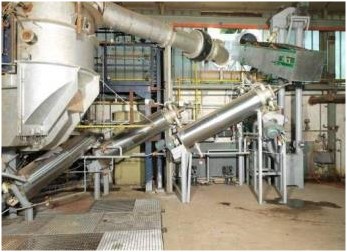
Three more processes follow this approach (see below):
- Michaelis-sePura Paddelofen Verfahren
- Werkstätten Heating Systems Drehrohrkessel Technologie
- Wehrle P-Xtract Verfahren
Updated 11/2025
Input materials
All ashes with P-content >7%. A source of sodium such as sodium carbonate, optionally magnesium.
Output products
Modified Rhenania Phosphate (Calcium-Sodium-Phosphate) Pnac solubility >80%; granular material with P2O5 content of 15-25% (depending on input-ash); no organic matter; product is blendable with all other fertilising products.
Process description
Ash is mixed with a sodium carrier (Na2CO3 or NaHCO3) and heated to about 850-900°C in a rotary kiln to modify the P-compounds to neutral-ammonium-citrate soluble CaNaPO4 (Rhenania Phosphate). Heavy metals are partly removed and captured in a baghouse filter from where they can be separated from the fertilising product as a small waste stream (3-5% of input material). Hence, > 97 % of phosphorus and other elements in input ash are recovered.
Recovery rate (P in final product / P in input ash): >95 %
Recovery rate (% from input ash in recycle stream) of iron, aluminium: >95%.
Removal of heavy metals (% from input ash in final phosphate product): Cd: ~ 50 % removal, Pb: ~10 %, As: ~ 50 %.
Cu, Zn and Ni are not removed from the ash with the standard process. Removal of Cu and Zn can be enhanced by use of chlorine additives.
Operating status
Within the funded R-Rhenania project, a thermochemical process based on the AshDec process was integrated in a grate-firing sewage sludge incineration plant in Altenstadt (Oberbayern), Germany, which incinerates 55000 t/y of sludge (as t dry matter). Started mid 2024, the plant produces 15000 tons of phosphorus fertilizer per year, equalling 1500 t/y of phosphorus (as P).
Pilot plant (300 kg/h, photo) operational for several years, Leoben, Austria. Continuous operating campaigns produced several hundred tons of product.
Apart from this large scale operation, several similar units exist on smaller scale, with their economy based on the avoidance of long distance transport of wet sewage sludge:
Werkstätten offers a drum calciner technology to dry and incinerate sewage sludge with optional sodium addition. From late 2024 a 1800 t/y plant has been operating in Michelstadt, Germany, with three more operations being built in Germany and Denmark. https://werkstaetten-gmbh.de/dezentrale-klaerschlammverwertung/
Michaelis-sePura has operated a paddle incinerator (German: Paddelofen) in Obernburg, Germany for industrial sludge since 2018 and plans to apply this technology to communal sludges with soidum addition. https://michaelis-systems.de/incineration-plants/
P-Xtract uses a fluidized bed, and (earth) alkali addition to generate a plant available phospahte while separating out heavy metals through the gas phase. A 1000 t/y plant operates in Grezhausen, Germany since 2024. https://www.wehrle-werk.de/produkte/p-xtract